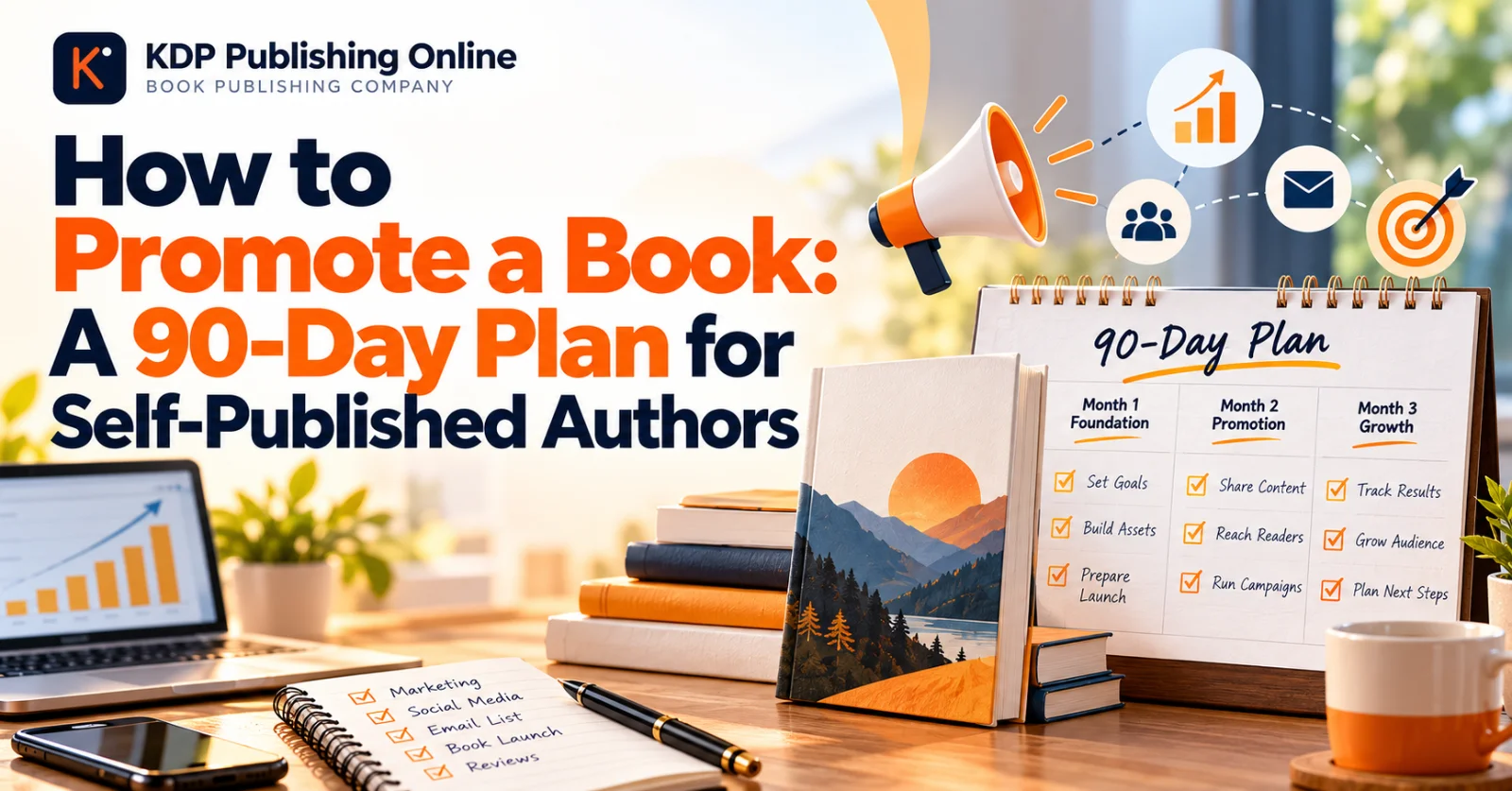
To promote a book, work in three phases over 90 days. In the first 30 days build your foundation: a strong product page, an email list and early readers. In days 31 to 45 run the launch with a price promotion. In days 46 to 90 test advertising and keep what works. Start with free channels, then add paid ones in small tests.
This guide is about choosing channels and budgets. For a task-by-task list, use our book launch checklist, and for the upload itself see our guide to self-publishing on KDP.
No marketing plan can guarantee sales or a bestseller ranking. A plan lets you test, measure and keep what pays for itself.
Three Ways To Promote a Book
| Type | Examples | Cost |
| Organic | Email list, social media, author website, podcasts, local events | Free, but costs time |
| Amazon tools | Author Central, A+ Content, KDP Select promotions, Amazon Ads, gifting | Some free, ads are pay-per-click |
| Third-party paid | Price-promotion sites, Meta ads, BookBub ads | Paid |
KDP's own list of promotion options includes KDP Select, Author Central (an author page on Amazon), Amazon Advertising, Expanded Distribution, gifting books and a marketing page with A+ Content and promotion nominations. Enrolling an eBook in KDP Select makes it exclusive to Amazon, so check that trade-off before you join.
Phase 1 (days 1 to 30): build the foundation
Ads and virality work only when the basics are in place. A Reedsy marketer who has managed over a million dollars in ad spend makes the same point: marketing starts with a strong book, a navigable product page and, if possible, an audience you built yourself.
- Fix the cover and description first. Your cover earns the click and your description earns the sale. Reedsy ran an experiment in which a professionally redesigned cover earned more ad clicks in six of seven genres, up to 164% more in one.
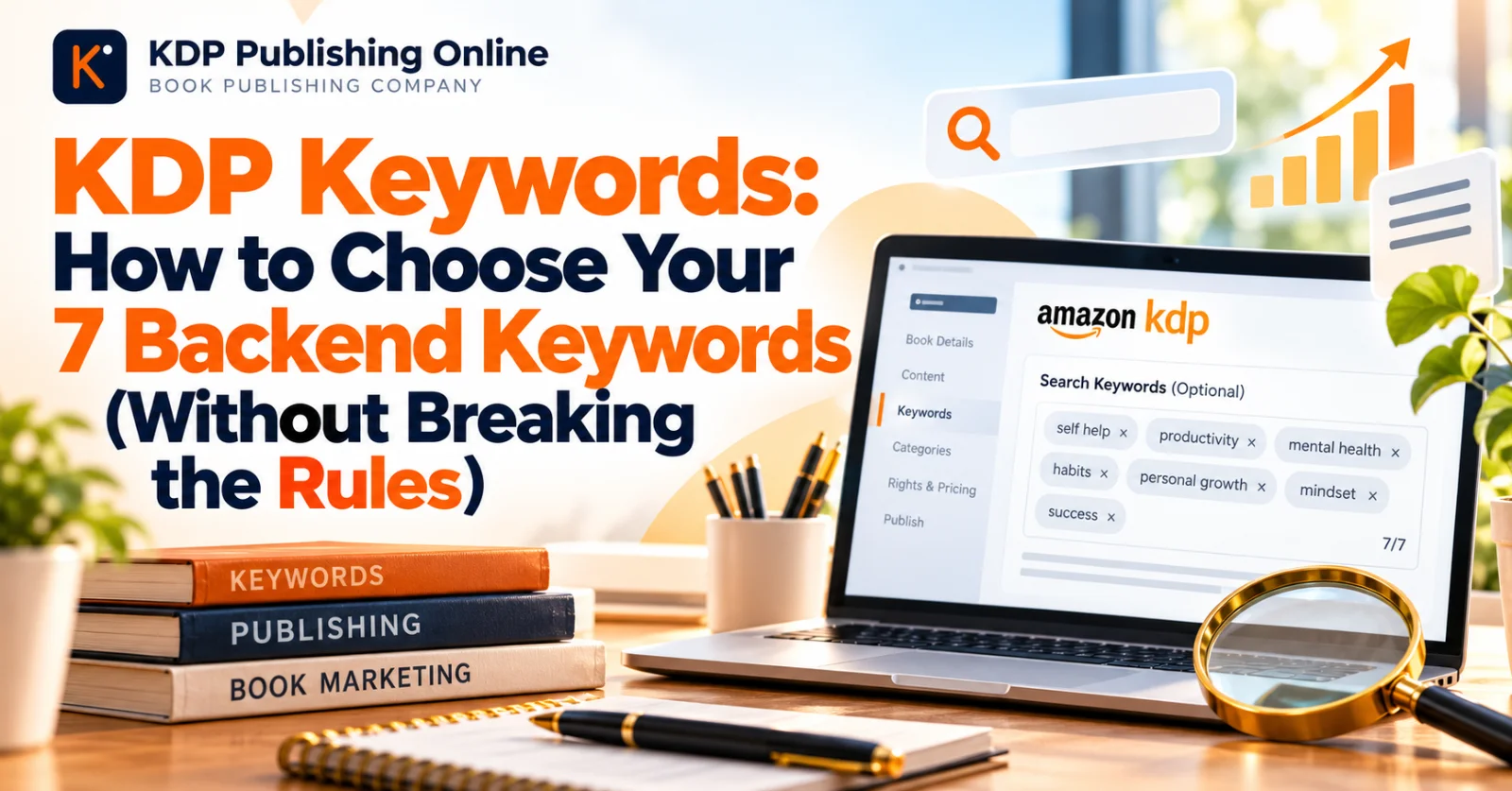
- Set keywords and categories. Follow our KDP keywords guide.
- Keep your details consistent. Use the same cover, description and author bio on Amazon, Goodreads and your own site.
- Start an email list. Offer a reader magnet, such as a free chapter, checklist or short story, in exchange for an address. Reedsy suggests starting 6 to 12 months before launch where you can, and says even a few hundred engaged subscribers can produce launch-day sales and reviews.
- Recruit advance readers. Send advance copies at least a month before launch, ideally three to six months, to friends, genre communities and reviewers, with direct links to leave a review.
- Set up your author page. Create an Author Central page so readers can follow you.
If your book is already published, treat this phase as a relaunch. It is not too late to overhaul your cover, description and keywords, then build reviews and run a promotion.
Phase 2 (days 31 to 45): launch window
Your goal is sales velocity: getting many of the right readers to buy quickly.
- Run a price promotion. Lower the price for up to two weeks, or make the book free if you are in KDP Select. Reedsy lists a Kindle Countdown Deal (a discount for up to seven days, available on the US and UK stores) and a Free Promotion (up to five days). You can use one of the two per 90-day enrollment period.
- Tell your list and your advance readers. A paid purchase at a discount can show as a verified review.
- Mind Amazon's review rule. Reedsy notes that Amazon accepts reviews only from accounts that have spent at least $50 on the marketplace in the past 12 months with a card, so warn reviewers in advance.
- Never pay for reviews. Buying reviews breaks Amazon's rules and can put your account in trouble.
Phase 3 (Days 46 to 90): Test And Scale
Only invest in advertising after your page is ready. Reedsy's guidance on the main channels:
| Channel | Typical test cost (Reedsy) | Effort | Best for |
| Price-promotion sites | $20 to $200 per promotion | Low | Discounted or free eBooks |
| Amazon Ads | $5 to $10 a day to test | Medium | Almost all genres |
| Meta ads (Facebook, Instagram) | $10+ a day to test | Medium to high | Building lists, broad-appeal fiction |
| BookBub Ads | $5 to $10 per test campaign | Medium | Books sold beyond Amazon |
| TikTok, Instagram (organic) | Free | High | Visual genres such as romance, fantasy, young adult |
| Podcasts, influencers | Free to paid | High | Nonfiction and niche authorities |
Amazon Ads at $5 a day for 30 days is $150, and at $10 a day it is $300, which fits Reedsy's advice to expect a testing budget of a few hundred dollars. Only use social platforms you actually enjoy, because inconsistent posting rarely works.
Pick Your Budget Tier
| Tier | What you do | Cash needed |
| Free | Email list, author page, advance readers, social posts, author website, local outreach | $0 plus your time |
| Test | Everything above plus one promotion-site campaign and a 30-day Amazon Ads test | About $170 to $500 (one $20 to $200 promotion plus $150 to $300 of ads) |
| Growth | Add Meta or BookBub tests, a trailer, an author website and a professionally run launch | Quote-based |
Start in the Free tier unless your page is ready and you can afford to lose the test budget.
Track What Matters
Use a simple weekly table:
| Week | Email subscribers | Reviews | Ad spend | Clicks | Orders | Royalties earned |
| 1 | ||||||
| 2 | ||||||
| 3 |
To judge an ad, compute cost per sale: ad spend ÷ orders. For example (hypothetical numbers), $150 of ads that produce 40 orders costs $3.75 per sale. If your royalty is $4.39 per paperback (the example in our cost guide), you are ahead by about $0.64 a sale before other costs. If the cost per sale is higher than your royalty, change the cover, description or targeting before spending more.
Write the Next Book
A series lets one reader buy several books. Reedsy points out that series dominate bestseller lists in romance, mystery, fantasy and thrillers, and that read-through, the share of readers who continue to the next book, makes ads on book one profitable. You can also rotate promotions across your titles.
Mistakes to Avoid
- Spending on ads before the cover and description are ready.
- Starting marketing the week the book is released.
- Running one tactic once and judging the whole plan on it.
- Posting on a platform you dislike.
- Paying anyone who guarantees bestseller status.
- Ignoring the numbers. Without tracking you cannot tell what worked.
Frequently Asked Questions
How do I promote my book for free?
Build an email list with a free reader magnet, set up an author page, ask advance readers for honest reviews, post where your readers already are, and pitch podcasts or local outlets.
When should I start promoting a book?
Ideally 6 to 12 months before launch for your list, and 1 to 3 months before for your product page and reviews. If the book is already out, start now and treat it as a relaunch.
How much should I spend on book marketing?
Start at $0 and test with a small budget. Reedsy suggests $5 to $10 a day to test Amazon Ads and $20 to $200 per promotion-site campaign. Only scale what earns more than it costs.
Are Amazon Ads worth it?
For many authors they are an effective channel because they reach readers who are already shopping, but they take testing. Judge them by cost per sale against your royalty.
Can you guarantee my book will sell?
No one can, including us. We help you build a plan, run it properly and measure the results.
Want a Professional Launch Plan?
If you would rather have a team plan and run your promotion, see our book marketing service or get a free quote. We never promise bestseller status or guaranteed sales.